Late on 26 August 1346, on a ridge above the village of Crécy in northern France, a small English army under Edward III waited for the French. Edward had spent six weeks raiding across Normandy and had just escaped over the Somme. Now he chose his ground: a gentle slope with a river and a village on one flank and woods on the other. He dismounted his knights to fight on foot and placed thousands of longbowmen on the wings. King Philip VI of France arrived with a far larger army, full of the finest mounted knights in Europe. It was late, the troops were strung out on the march, and a thunderstorm had just passed. The French sent forward their Genoese crossbowmen, who were quickly outshot by the longbowmen. The French knights then rode through their own crossbowmen and charged uphill again and again, as many as fifteen times, into a storm of arrows. Horses fell and piled up in front of the English line, and the charges that got through broke on the dismounted men-at-arms of Edward's 16-year-old son, the Black Prince. By nightfall the flower of French chivalry lay dead on the slope. Crécy showed that disciplined infantry with missile weapons, in a good defensive position, could destroy mounted knights. It is a landmark in how technology changes the battlefield.
1. Summary card
| Field | Value |
|---|---|
| Name (and other names) | Battle of Crécy |
| Date(s) | 26 August 1346, from late afternoon until after dark; fighting continued the next morning |
| Period / Region code | P07 / WE |
| Location (modern place, country) | Crécy-en-Ponthieu, Somme, France |
| Coordinates (lat, long) | 50.25, 1.88 (the traditional site; see section 12) |
| War / campaign | Hundred Years' War; Edward III's Normandy campaign (the chevauchée of 1346) |
| Type | land |
| Result | Decisive English victory; heavy losses among the French nobility |
| Technology | English longbow (decisive): massed archers outshot the crossbow and broke cavalry charges. Early gunpowder cannon were probably present on the English side (Villani), but had little effect. |
| Why it matters (one sentence) | Massed longbowmen and dismounted men-at-arms in a strong position destroyed a larger army of mounted knights, showing that the knight's charge could be beaten. |
| Record status | draft |
2. Leaders
| Side | Name | Role in battle | Background and reputation before | Known intent / plan | How they performed |
|---|---|---|---|---|---|
| England | Edward III | King; commanded from a windmill behind the centre, with the reserve | Aged 33. Had won the naval battle of Sluys (1340) and claimed the French throne. | Choose strong ground, fight on foot, and let the French attack into the archers. | Excellent. Chose and prepared the ground well, kept a reserve and did not over-commit it. |
| England | Edward, the Black Prince | Nominal commander of the right-hand division (the vanguard) | Aged 16; his first battle. Advised by the Earls of Warwick and Oxford. | Hold the right, where the French attack would fall hardest. | His division took the heaviest attacks and held. Froissart says the King refused to send help: "let the boy win his spurs". |
| England | William de Bohun, Earl of Northampton, and Richard Fitzalan, Earl of Arundel | Commanded the left-hand division | Experienced commanders; Northampton had won at Morlaix (1342) with similar tactics. | Hold the left towards Wadicourt. | Held; less heavily attacked. |
| France | Philip VI | King; commanded the main army | Aged 53. First of the Valois kings; had shadowed Edward across northern France. | Catch and destroy the English army before it escaped north. | Unable to control his army once contact was made; attacked late in the day without waiting to form up. Wounded; left the field at night. |
| France | Charles, Count of Alençon | The King's brother; led the first division of cavalry | Senior nobleman. | Charge and break the English line. | Rode through his own crossbowmen and led the first charges; killed. |
| France | John, King of Bohemia | Allied king in the first division | Aged 50 and blind; famous knight. | Take part in the charge. | Had his knights tie their horses to his and lead him into the fighting; killed. |
| France | Ottone Doria and Carlo Grimaldi | Commanded the Genoese crossbowmen | Professional mercenary captains. | Shoot down the English archers before the cavalry charge. | Outranged and outshot; their men retreated and were ridden down by the French cavalry. |
3. Forces
| England (Edward III) | France (Philip VI) | |
|---|---|---|
| Estimated strength (low–high, cite) | Modern estimates: about 7,000–15,000 in all. Ayton & Preston (2005) give about 14,000: about 2,500 men-at-arms, 5,000 longbowmen, 3,000 hobelars (light horsemen and mounted archers) and 3,500 spearmen. | Chroniclers give figures of 100,000 and more. Modern estimates: about 20,000–30,000, including 2,000–6,000 Genoese crossbowmen and perhaps 8,000–12,000 mounted men-at-arms. |
| Composition | Men-at-arms fighting on foot; longbowmen; Welsh spearmen and light infantry; a few early cannon | Mounted men-at-arms (knights and squires); Genoese crossbowmen; large numbers of militia infantry, many arriving late |
| Key weapons / technology | The longbow (about 1.8 m of yew; perhaps 6–10 or more aimed shots a minute and a range of 200–250 m); plate and mail armour; early cannon (ribaudequins) | The crossbow (slower to load, perhaps 2 shots a minute; its large shield, the pavise, was left with the baggage); the heavy cavalry charge with the lance |
| Morale, training, supply | Veterans of a six-week campaign; tired and short of food, but disciplined and confident in their leaders and ground | Proud, eager for battle, but tired from a long march; discipline broke down as divisions arrived and attacked piecemeal |
| Casualties (low–high, cite) | Light; modern estimates range from about 40 to a few hundred. | Very heavy among the nobility: 1,542 knights and squires counted dead in front of the Prince's division alone, by the English heralds (reported in Michael Northburgh's letter). In all, about 2,000 knights and squires plus an unknown number, perhaps several thousand, of common soldiers. |
4. Strategic context
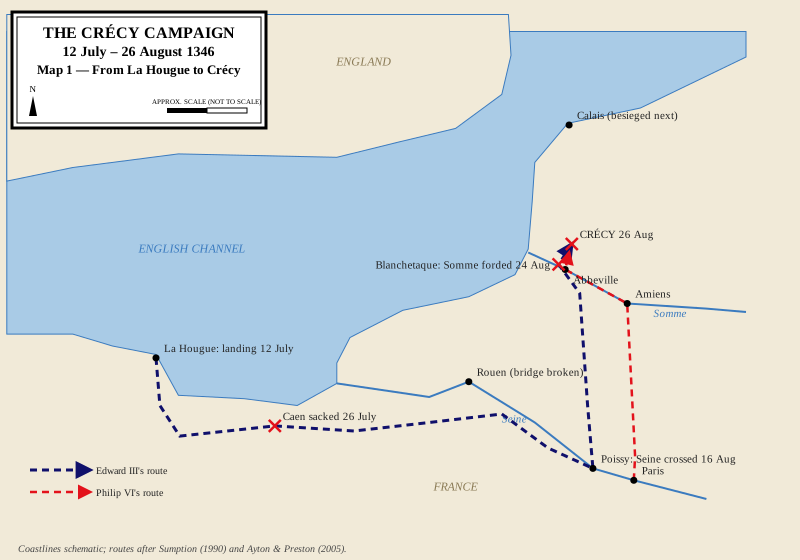
- England's aim. Edward III claimed the French throne. In July 1346 he landed at La Hougue in Normandy and marched across the country, burning and plundering (a chevauchée), sacking Caen and shaking Philip VI's authority. He hoped to fight only on ground of his own choosing, then reach the Channel coast and his allies in Flanders.
- France's aim. Philip VI needed to destroy the invading army to restore his prestige. He broke the bridges on the Seine and the Somme to trap Edward south of the rivers.
- Why here. Edward crossed the Seine at Poissy and the Somme at the tidal ford of Blanchetaque on 24 August, forcing a crossing against French defenders. Now across the Somme, and in his own county of Ponthieu, he decided to turn and fight on a ridge he chose near Crécy. Philip, following from Abbeville, reached the field late on the 26th.
5. Terrain and weather
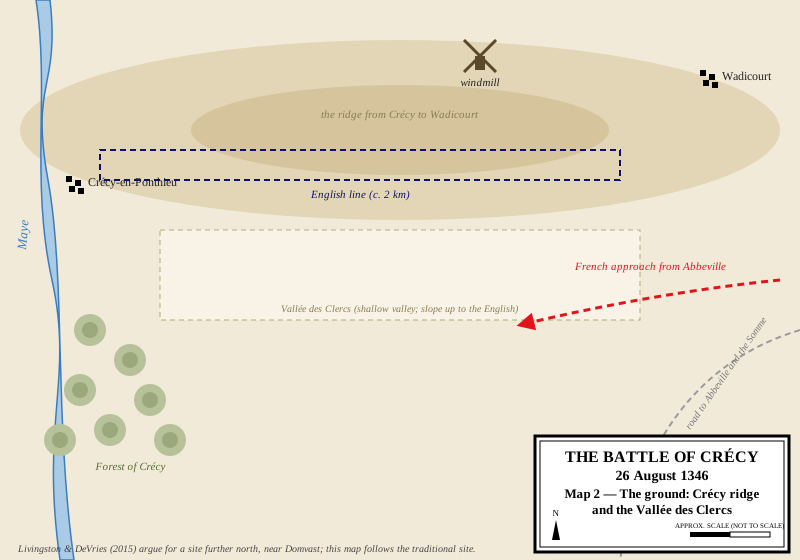
- Ground. A ridge running north-east from Crécy towards Wadicourt, facing south-east over a shallow valley, the Vallée des Clercs. The English right was covered by the village of Crécy and the River Maye; the left by the village of Wadicourt and woods. The English dug small pits in front of their line to trip horses, and Villani says the army was protected by a laager of carts.
- Weather. A short, heavy thunderstorm fell just before the battle. By the time the French attacked in the late afternoon, the sun was low and shining in their faces (Froissart).
- How terrain shaped the battle. The French had to attack uphill, across a narrowing front between the village and the woods. Wounded and dead horses piled up at the foot of the slope, so each later charge had to cross the wreck of the one before.
6. Maps
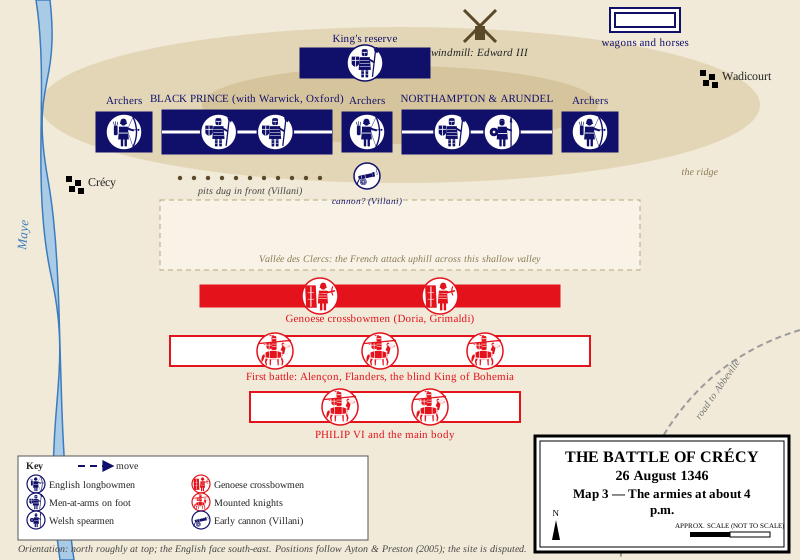
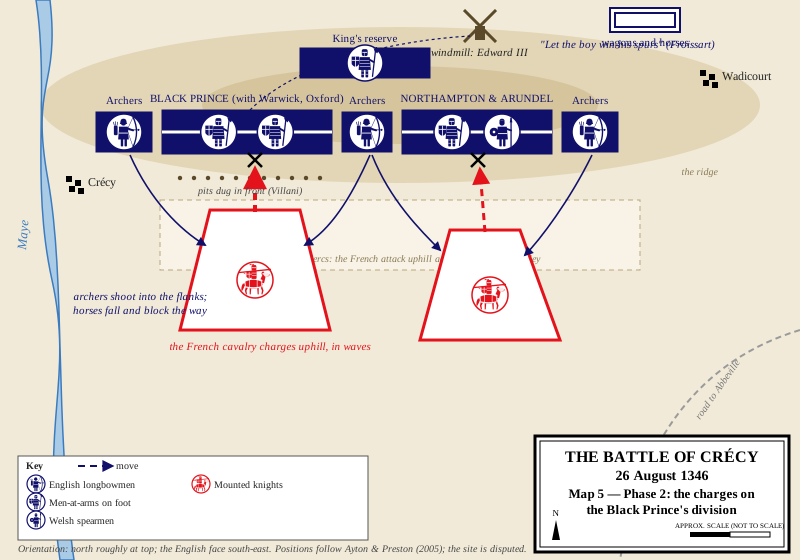
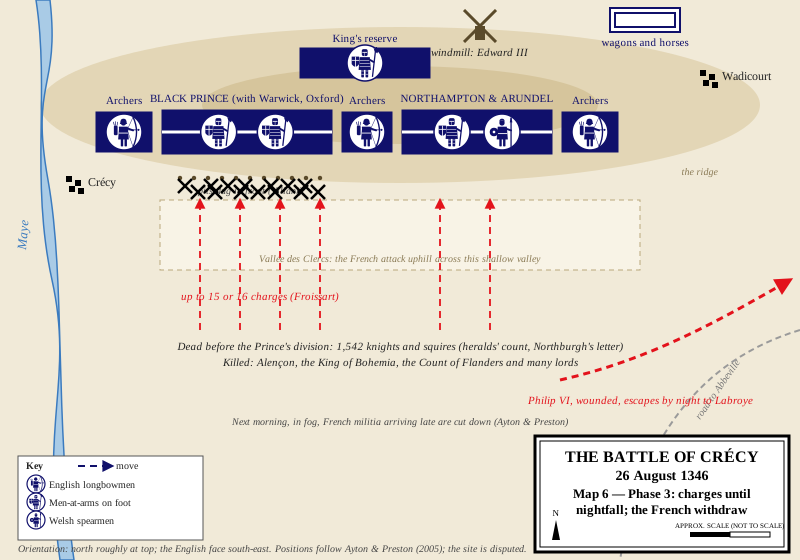
Maps follow the house style: tan landscape, troop blocks in each side's colour (England navy, France red), pictorial troop figures (longbowman, men-at-arms on foot, Welsh spearman, Genoese crossbowman with his shield, mounted knight, early cannon), dashed arrows for movement, solid arrows for arrow volleys, a key and a title box. North is roughly at the top; the English face south-east.
| # | Map | Shows | File | Drawn from | Confidence |
|---|---|---|---|---|---|
| 1 | Campaign | Edward's route from La Hougue to Crécy; Philip's route from Paris | 01-campaign.svg | Sumption (1990); Ayton & Preston (2005) | high |
| 2 | Terrain | The ridge, the Maye, the Vallée des Clercs, the windmill, the forest | 02-terrain.svg | Ayton & Preston (2005) | medium (the site is disputed) |
| 3 | Initial deployment | The three English divisions and the archers; the French army arriving | 03-deployment.svg | Froissart; le Bel; Ayton & Preston | medium (the archers' exact placing is disputed) |
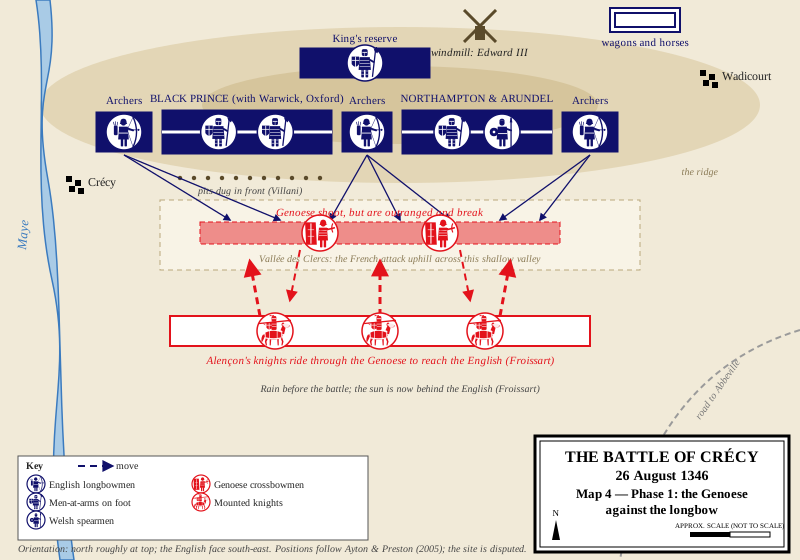
| 4 | Phase 1 | The Genoese against the longbow | 04-phase1.svg | Froissart; Villani | high |
| 5 | Phase 2 | The cavalry charges on the Black Prince's division | 05-phase2.svg | Froissart; le Bel | high |
| 6 | Phase 3 / final | Charges until nightfall; the French withdraw | 06-final.svg | Northburgh's letter; Froissart | high |
7. Course of the battle (phases)
| Phase | Time | What happened | Map # |
|---|---|---|---|
| 1 | About 4–5 p.m. | Without waiting for his whole army to arrive, Philip sends the Genoese crossbowmen forward. They shoot, but at longer range and much faster the longbowmen outshoot them. Froissart says rain had slackened the crossbow strings, and their pavises were still with the baggage. The Genoese fall back. | 4 |
| 2 | Early evening | Taking the retreat for treachery, the French men-at-arms of the first division ride through and over the Genoese and charge uphill. The archers, placed on the flanks, shoot into the horses; the charge breaks up at the pits and the heaps of fallen horses. Those who reach the line meet the dismounted men-at-arms of the Black Prince's division in hard fighting. Edward keeps his reserve back. | 5 |
| 3 | Evening to night | Each arriving French division charges in turn, as many as 15 or 16 times (Froissart), with the same result. Alençon, the King of Bohemia, the Count of Flanders and many great lords are killed. Philip, wounded, leaves the field at night for the castle of Labroye (also given as La Boissière). | 6 |
| 4 | Next morning | In fog, French militia and late-arriving contingents who did not know of the defeat are attacked and scattered. | 6 |
8. Key moments
- Choosing the ground. Edward picked a slope with both flanks covered. The alternative, being caught on the march, would have let the French cavalry use their full weight and numbers.
- Fighting on foot. Edward dismounted his men-at-arms, making a solid line that horses would not break through. A mounted English force would have been outnumbered in a cavalry fight.
- The Genoese broken first. The longbow's rate and range beat the crossbow in the opening exchange. Had the Genoese had their pavises and held, the French could have worn down the archers before charging.
- The French attack without order. Philip let the battle start late in the day with his army still arriving. Each division charged on its own. A pause until the next morning, with the whole army formed up, would have given the French a far better chance.
- The reserve held back. Edward did not commit his reserve to help his son, keeping it for a real crisis that never came.
9. Tactics and strategy analysis
- England: what worked. A strong defensive position; infantry that did not break; missile weapons used in mass on the flanks to shoot into attacking cavalry; field obstacles; a reserve under the King's eye. The combination of archers and dismounted men-at-arms became the English system of the Hundred Years' War.
- England: what failed. Little on the day. Strategically, the victory did not win the French crown; it led instead to the long siege of Calais.
- France: what worked. The French knights showed enormous courage, attacking again and again.
- France: what failed. Command and timing. The army attacked piecemeal and late, the crossbowmen were sent in without their shields, and the cavalry rode down their own infantry. The French answer to the longbow, charging harder, could not work against a strong position.
- Principles illustrated. The defensive battle on chosen ground; firepower against shock; combined arms (archers with dismounted men-at-arms); the danger of attacking before forming up.
- Counterfactual. Had Philip camped for the night and attacked the next morning with his whole army formed, or simply blocked Edward's route and made him attack, the English, short of food, might have had to fight on French terms.
- Technology. Crécy is a step on the technology timeline: the longbow, used in mass and well protected, beat both the crossbow and the mounted knight. It is also one of the first battles in Europe where gunpowder cannon may have been used, though they changed little.
10. Aftermath and legacy
- Immediate. Edward marched north and besieged Calais, which surrendered in August 1347 and stayed English until 1558.
- Longer term. The same English system won again at Poitiers (1356) and Agincourt (B047, 1415). The prestige of the mounted knight began a long decline across Europe, as infantry armed with bows, then pikes and later firearms, took over the battlefield.
- How later commanders studied it. Crécy became the model of the defensive battle: choose the ground, make the enemy attack, and destroy him with missile fire. The same pattern appears at Agincourt and, with firearms, in many later battles.
11. Comparisons
- Technology step: B047 Agincourt (the longbow again, 69 years later); on the timeline, before it comes B013 Gaugamela (cavalry beats chariots) and after it B051 Pavia (the arquebus kills knights).
- Tactic pair candidate: the defensive position and missile fire, as here, against a later counter that attacked the archers before they could set up (Patay, 1429, not yet on our list).
- Same leader and war: B047 Agincourt was fought by Edward's great-grandson Henry V.
12. Sources and disputes
- Primary. Jean Froissart, Chronicles (book I; several versions); Jean le Bel, True Chronicles; Giovanni Villani, Nuova Cronica; the letters of Michael Northburgh and Richard Wynkeley, clerks with the English army; the Grandes Chroniques de France; Geoffrey le Baker, Chronicon; the Acta Bellicosa (an English campaign diary).
- Secondary. Andrew Ayton and Philip Preston, The Battle of Crécy, 1346 (2005); Jonathan Sumption, Trial by Battle: The Hundred Years War I (1990); Alfred H. Burne, The Crecy War (1955); Michael Livingston and Kelly DeVries (eds.), The Battle of Crécy: A Casebook (2015).
- Disputes.
- Numbers. The chroniclers' figures are far too high. This record gives the modern ranges.
- The site. The traditional site near Crécy is followed here; Livingston and DeVries (2015) argue for a site further north, near Domvast.
- The archers' formation. Froissart's word herse has been read as wedges between the divisions or as blocks on the flanks. The maps show archers on the flanks and between the divisions.
- The crossbow strings. Froissart says the rain slackened the Genoese strings; some historians doubt this, as the English bows would have been wet too (archers could unstring and protect their bows).
- Cannon. Villani and some French sources mention English cannon; others do not. This record treats them as probably present but of little effect.
- The Black Prince. The story of Edward's refusal to send help ("let the boy win his spurs") is Froissart's and may be embellished.