On 1 October 331 BCE, on a wide plain in northern Mesopotamia, Alexander of Macedon met the full army of the Persian Empire under its king, Darius III. Darius had chosen the ground and even levelled it so that his scythed chariots and his far larger cavalry could sweep round the small Macedonian army. Alexander refused to fight on those terms. He led his army at an angle across the Persian front, edging to the right and off the prepared ground, and drew the Persian left-wing cavalry out to stop him. As they rode out, a gap opened in the Persian line. Alexander formed his Companion cavalry and the infantry beside them into a wedge, drove through the gap and made straight for Darius. The king fled, and his centre collapsed behind him. It was not a clean win: gaps also opened in the Macedonian line, Persian horsemen rode through to loot the camp, and Parmenion's left wing came close to breaking before Alexander turned back to help. By nightfall the Persian army had dissolved. Gaugamela ended the Persian Empire and is the classic study of breaking through at the decisive point, the tactic whose danger the Romans would learn at Cannae (B017).
1. Summary card
| Field | Value |
|---|---|
| Name (and other names) | Battle of Gaugamela; also called the Battle of Arbela |
| Date(s) | 1 October 331 BCE (Plutarch, Alexander 31, places a lunar eclipse eleven days before; that eclipse is dated 20 September 331) |
| Period / Region code | P03 / ME |
| Location (modern place, country) | Near Tel Gomel, about 30 km north-east of Mosul, Iraq |
| Coordinates (lat, long) | 36.57, 43.44 (approximate; the exact field is not known) |
| War / campaign | Alexander's conquest of the Persian Empire, fourth year |
| Type | land |
| Result | Decisive Macedonian victory; Darius fled and the Persian royal army broke up |
| Technology | Scythed chariots failed against javelin men and open lanes; the sarissa phalanx and the heavy-cavalry wedge decided (a step on the technology timeline: cavalry replaces the chariot). |
| Why it matters (one sentence) | A smaller army beat a much larger one by drawing it out of position and striking through the gap at its commander, ending the Persian Empire. |
| Record status | draft |
2. Leaders
| Side | Name | Role in battle | Background and reputation before | Known intent / plan | How they performed |
|---|---|---|---|---|---|
| Macedon | Alexander III ("the Great") | King; led the Companion cavalry on the right | Aged 25. Had beaten the Persians at the Granicus (334) and Issus (333), and taken Tyre and Egypt. | Refuse the prepared ground, pull the Persian wings out of line, then strike at Darius himself. | Decisive. Timed the wedge exactly; was criticised by some ancient writers for leaving Parmenion hard pressed. |
| Macedon | Parmenion | Commanded the left wing and the Thessalian cavalry | About 70; Philip II's senior general; Alexander's second in command. | Hold the left against the larger Persian right while Alexander attacked. | Held under very heavy pressure; sent for help (Arrian 3.15.1; Plutarch, Alexander 33). Callisthenes, cited by Plutarch (Alexander 33), blamed him for being slow. |
| Macedon | Craterus | Commanded the left-hand phalanx battalions | Senior infantry officer, later one of Alexander's chief generals. | Keep the phalanx closed up with the left wing. | Held. A gap opened in the phalanx when Simmias's battalion halted to help the left (Arrian 3.14.4). |
| Persia | Darius III | Great King; in the centre with the royal guard | Had ruled since 336. Had fled from Issus two years earlier, leaving his family to be captured. | Envelop the Macedonian flanks with cavalry and break the front with chariots and elephants. | Chose good ground and a sound plan, but left the field when Alexander's wedge came near, and his army broke with him (Arrian 3.14.3). Diodorus 17.60 says he fled only when his charioteer was killed. |
| Persia | Bessus | Satrap of Bactria; commanded the left-wing cavalry | Governor of Darius's eastern provinces; had the best cavalry in the empire. | Outflank Alexander's right. | Fought hard but was drawn out of line, opening the gap. Later murdered Darius (330). |
| Persia | Mazaeus | Satrap; commanded the right-wing cavalry | Experienced governor of Syria and Mesopotamia. | Outflank and crush Parmenion. | Came close to winning on his wing; withdrew in good order when the centre fled. Surrendered Babylon to Alexander weeks later. |
3. Forces
| Macedon and allies (Alexander) | Persian Empire (Darius III) | |
|---|---|---|
| Estimated strength (low–high, cite) | 40,000 infantry and 7,000 cavalry (Arrian 3.12.5). | Ancient figures are impossible: Arrian 3.8.6 gives 1,000,000 infantry and 40,000 cavalry; Diodorus 17.53 gives 800,000 and 200,000; Curtius 4.12.13 gives 200,000 and 45,000. Modern estimates range from about 50,000 to 100,000, with far more cavalry than Alexander. |
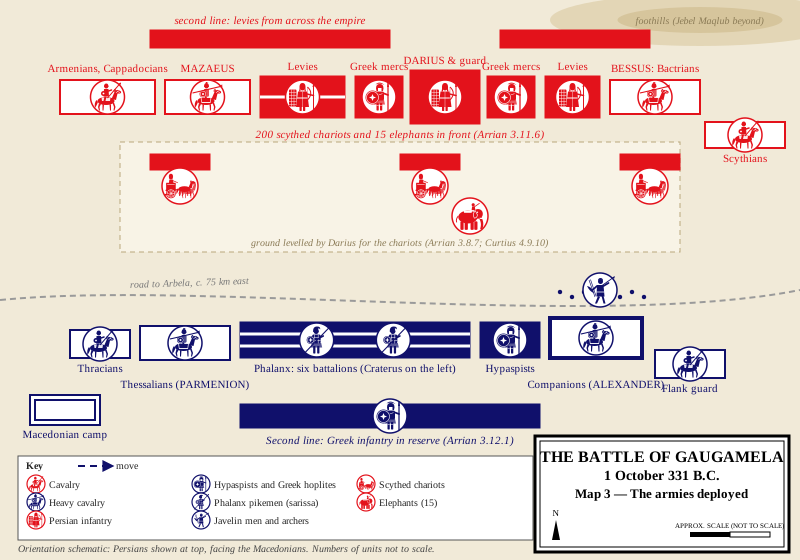
| Composition | Macedonian phalanx with the sarissa (pike about 5.5 m long); hypaspists (elite infantry); Companion and Thessalian heavy cavalry; allied Greek cavalry and infantry; Agrianian javelin men, archers and light cavalry | Heavy cavalry from Bactria, Scythia, Armenia and Cappadocia; royal guard infantry; Greek mercenary hoplites; levies from across the empire; 200 scythed chariots; 15 elephants (Arrian 3.8.6) |
| Key weapons / technology | The sarissa phalanx; heavy cavalry trained to charge in wedge formation | Scythed chariots with blades on the wheels; armoured horsemen; archers |
| Morale, training, supply | Veterans of three years of victory; highly trained; well supplied | Mixed quality; the best were the eastern cavalry and the Greek mercenaries; many levies had little training |
| Casualties (low–high, cite) | About 100 dead according to Arrian 3.15.6; Curtius 4.16.26 gives 300; Diodorus 17.61 gives 500. Many more wounded. | Arrian 3.15.6 gives 300,000 killed; Diodorus 17.61 gives 90,000; Curtius 4.16.26 gives 40,000. All are guesses. |
4. Strategic context
- Macedon's aim. After Issus, Alexander took the coast of the Levant and Egypt, cutting the Persian fleet off from its bases. He then turned inland to finish the empire by destroying its army and capturing Darius.
- Persia's aim. Darius had two years to raise a new army from the eastern provinces, which were rich in cavalry. He needed one decisive victory on open ground of his own choosing, where his numbers and cavalry would count.
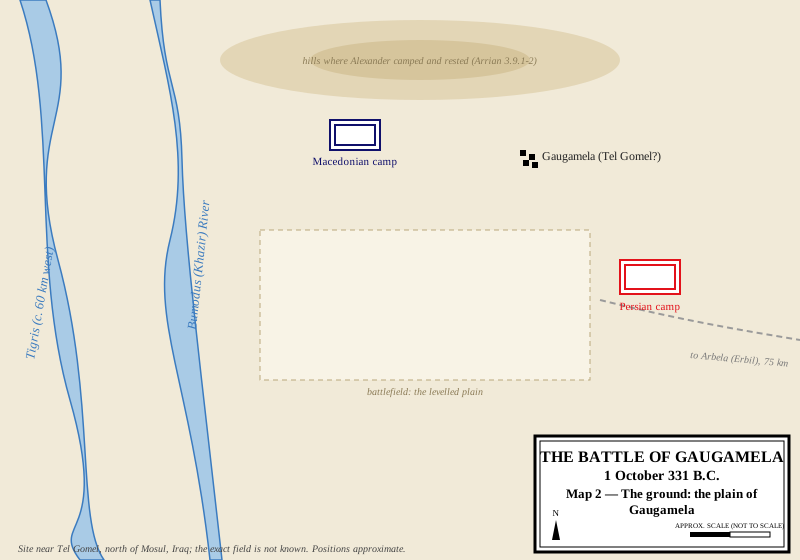
- Why here. Darius chose the flat plain near Gaugamela and had it levelled for his chariots (Arrian 3.8.7; Curtius 4.9.10). Alexander crossed the Euphrates at Thapsacus and the Tigris, then rested his army four days before advancing to the ridge overlooking the Persian army (Arrian 3.9.1–4). The Persians stood to arms all night fearing a night attack, so they began the battle tired (Arrian 3.11.1).
5. Terrain and weather
- Ground. A broad, open plain between low hills and the Bumodus (Khazir) River. The Persians had cleared and levelled a strip in front of their line so that the chariots could charge at full speed.
- Weather. Early autumn: dry and warm. The battle was fought in daylight after the Persians had spent the night under arms.
- How terrain shaped the battle. The open plain favoured Darius's cavalry and chariots. Alexander's answer was to march across it at an angle, moving right towards rougher ground. That forced Darius either to let him leave the levelled strip or to send cavalry out to stop him, stretching the Persian line.
6. Maps
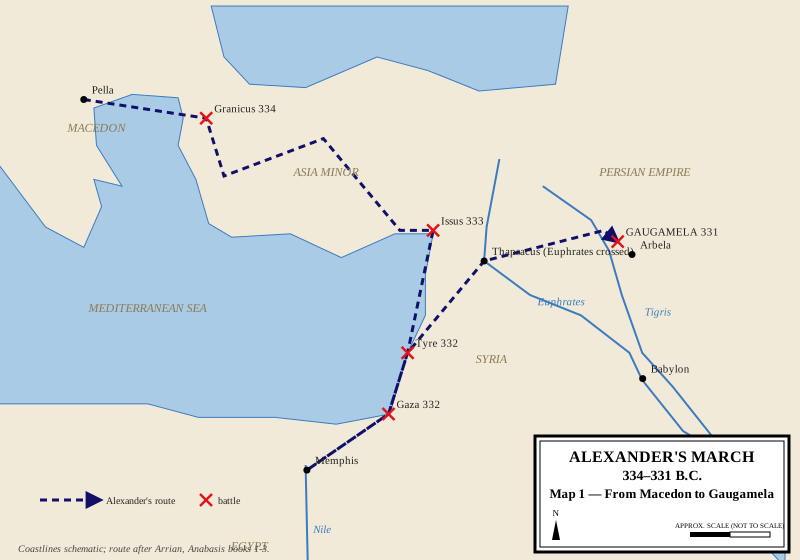
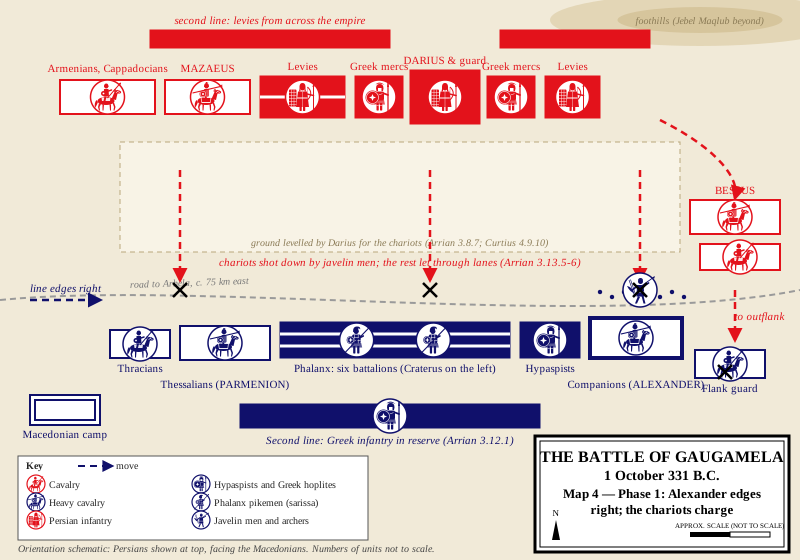
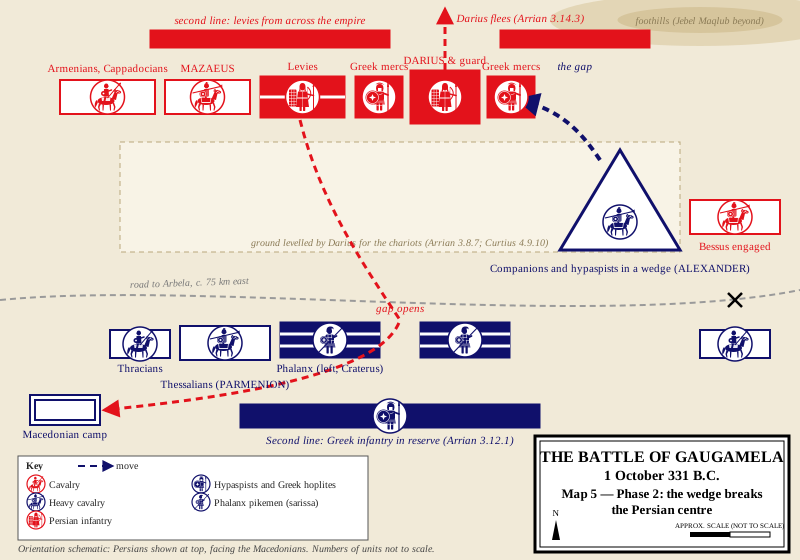
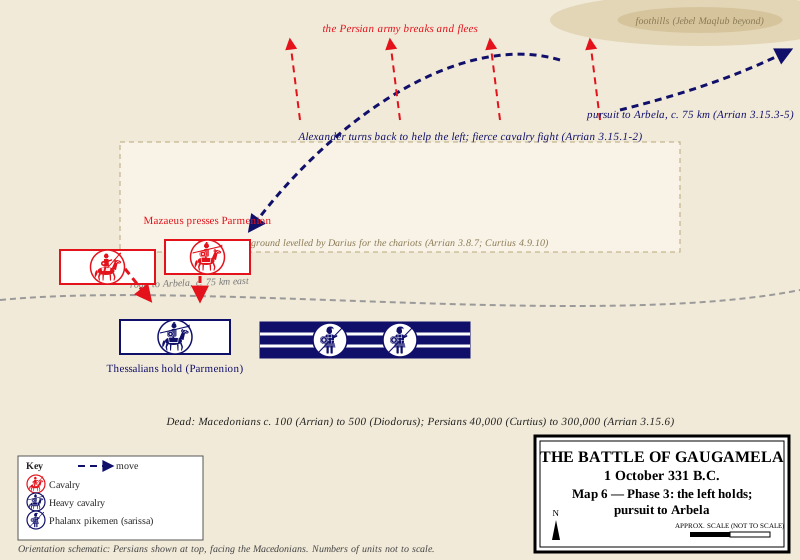
Maps follow the house style: tan landscape, troop blocks in each side's colour (Macedon navy, Persia red), pictorial troop figures, dashed arrows for movement, a key and a title box. North is only approximately at the top on the battle maps; the Persians are drawn at the top, facing the Macedonians.
| # | Map | Shows | File | Drawn from | Confidence |
|---|---|---|---|---|---|
| 1 | Campaign | Alexander's route 334–331: Granicus, Issus, Tyre, Egypt, Thapsacus, Gaugamela | 01-campaign.svg | Arrian, Anabasis 1–3 | high |
| 2 | Terrain | The plain, the Bumodus River, the hills, both camps, the road to Arbela | 02-terrain.svg | Arrian 3.8–9; modern site studies | low (the exact field is not known) |
| 3 | Initial deployment | Both lines, chariots and elephants in front, the Macedonian second line | 03-deployment.svg | Arrian 3.11–12 (Persian order from a captured battle plan, 3.11.3) | high for the order, low for widths |
| 4 | Phase 1 | The drift to the right; Bessus rides out; the chariots charge | 04-phase1.svg | Arrian 3.13 | medium |
| 5 | Phase 2 | The gap, the wedge, Darius flees; Persian horse break through to the camp | 05-phase2.svg | Arrian 3.14; Curtius 4.15 | medium |
| 6 | Phase 3 / final | Parmenion hard pressed; Alexander turns back; pursuit | 06-final.svg | Arrian 3.15 | medium |
7. Course of the battle (phases)
| Phase | Time | What happened | Map # |
|---|---|---|---|
| 1 | Morning | Alexander advances with his line angled, moving to the right beyond the edge of the levelled ground (Arrian 3.13.1). Darius sends Bessus's Scythian and Bactrian cavalry out to stop him, and a hard cavalry fight begins on the Macedonian right. The scythed chariots charge; javelin men shoot the drivers and horses, and the infantry open lanes to let the rest through harmlessly (Arrian 3.13.5–6). | 4 |
| 2 | Midday | As more Persian cavalry ride out to the flank, a gap opens in the Persian left centre (Arrian 3.14.2). Alexander forms the Companions and the nearest infantry into a wedge and charges through it towards Darius. Darius flees (Arrian 3.14.3), and his centre gives way. On the other side, Simmias's battalion of the phalanx halts to help the hard-pressed left, a gap opens beside it (Arrian 3.14.4), and Persian and Indian cavalry ride through to loot the Macedonian camp; the second line turns about and drives them off (Arrian 3.14.4–6). | 5 |
| 3 | Afternoon to evening | Mazaeus's cavalry press Parmenion's wing hard. Parmenion sends for help; Alexander breaks off the pursuit and turns back, meeting Persian cavalry in the fiercest fight of the day (Arrian 3.15.1–2). When the Persian right learns that Darius has fled, it withdraws. Alexander pursues to Arbela, about 75 km by modern estimate, but Darius escapes (Arrian 3.15.3–5). | 6 |
8. Key moments
- Refusing the prepared ground. Instead of attacking straight into the levelled strip, Alexander moved right. The alternative, a frontal advance, would have given the chariots and the cavalry the fight Darius had prepared for.
- Luring Bessus out. Alexander used his flank guard to keep the Persian left busy, drawing more and more cavalry away from the main line. Without this, there would have been no gap.
- The wedge at the gap. Alexander held the Companions back until the gap appeared, then struck at once and at the Persian king himself. A charge earlier would have met a solid line; a charge later would have found the gap closed.
- Darius leaves the field. Once the king fled, the army lost its centre of command. Had he held, the Persian wings, which were winning, might have closed round the Macedonians.
- The second line. Alexander's reserve line, ordered to face about if surrounded (Arrian 3.12.1), stopped the raid on the camp from turning into an attack on the rear.
9. Tactics and strategy analysis
- Macedon: what worked. Alexander made the enemy move first. The angled advance and the flank guard stretched the Persian line until it opened. The combination of a solid infantry front (the anvil) with a heavy-cavalry strike (the hammer) put overwhelming force at one point, aimed at the enemy commander.
- Macedon: what failed. The breakthrough opened gaps in Alexander's own line as units advanced at different speeds. Persian horsemen got through to the camp, and the left wing nearly collapsed. Victory depended on Darius fleeing before the Persian wings could exploit Macedonian gaps.
- Persia: what worked. A sound plan on well-chosen ground; the cavalry on both wings fought well and Mazaeus came close to breaking Parmenion.
- Persia: what failed. The chariots were easily neutralised. Sending more and more cavalry out to the flank thinned the centre. Most of all, the army depended on one man: when Darius left, the army followed.
- Principles illustrated. Breakthrough at the decisive point; manoeuvre before combat; combined arms (hammer and anvil); targeting the enemy commander; a reserve to protect the rear.
- Counterfactual. Had Darius stayed on the field for another hour, Mazaeus might have broken the Macedonian left and the Persian cavalry could have closed on the rear of Alexander's wedge.
- The pairing with Cannae (B017). Gaugamela shows the breakthrough working: a thrust through the gap to the enemy's heart. Cannae shows its weakness. The Romans at Cannae packed their army deep to break through the centre; Hannibal let them push in, then closed on both flanks. A breakthrough succeeds when the enemy line is stretched and its command fails, as at Gaugamela. It becomes a trap when the enemy gives ground on purpose and keeps reserves to close behind, as at Cannae.
10. Aftermath and legacy
- Immediate. Babylon surrendered to Alexander, followed by Susa and Persepolis with the royal treasuries. Darius fled east and was murdered by Bessus in 330.
- Longer term. The Achaemenid Persian Empire, which had ruled from the Aegean to India for two centuries, ended. Alexander marched on to Central Asia and India, and the Hellenistic kingdoms that followed his death shaped the Near East for three centuries.
- How later commanders studied it. Gaugamela became the model for the decisive battle of manoeuvre: fix the enemy, stretch the line, and strike at the gap. Napoleon's attacks on an enemy centre, such as at Austerlitz (B080), follow the same idea.
11. Comparisons
- Pair with B017 Cannae: the breakthrough succeeds here; at Cannae it is turned into a trap.
- Same leader: B014 Hydaspes (Alexander against Porus and his elephants).
- Same principle (breakthrough at the centre): B080 Austerlitz; B111 Sedan 1940.
- Same enemy, earlier: B009 Marathon and B011 Salamis (the Greeks against Persia).
12. Sources and disputes
- Primary. Arrian, Anabasis of Alexander 3.7–15 (written in the 2nd century CE from the accounts of Ptolemy and Aristobulus, who served under Alexander); Diodorus Siculus 17.53–61; Quintus Curtius Rufus, History of Alexander 4.9–16; Plutarch, Alexander 31–33.
- Secondary. A. B. Bosworth, Conquest and Empire (1988); Peter Green, Alexander of Macedon (1974; revised 1991); E. W. Marsden, The Campaign of Gaugamela (1964); J. F. C. Fuller, The Generalship of Alexander the Great (1958).
- Disputes.
- Persian numbers. The ancient figures are far too high. This record gives them with a note and uses the modern range of about 50,000 to 100,000.
- Macedonian losses. Arrian's figure of about 100 dead is probably too low; it may count only Companions.
- Darius's flight. Arrian says Darius fled first; Diodorus and Curtius say his charioteer was killed and the army thought the king had fallen. This record follows Arrian and notes the other version.
- Parmenion. Callisthenes, cited by Plutarch (Alexander 33), was hostile to Parmenion (executed in 330 on Alexander's orders), so the charge of slowness may be unfair. This record treats him neutrally.
- The site. Tel Gomel is the usual identification, but the field has not been located precisely.